





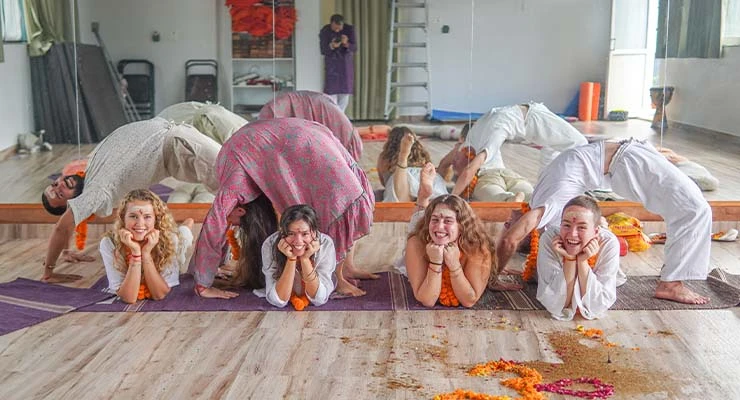
A lot of us go through our days automatically. We pay little attention to the physical vessel that carries us through life as we hurry from one duty to the next, our minds focused on past experiences or future aspirations. Chronic discomfort, injuries, and a mild but enduring sense of being ungrounded can result from this detachment from our body. By developing body awareness, or interoception—the ability to hear and comprehend your body’s internal cues—yoga provides a potent and straightforward route back to oneself.
In order to strengthen this vital bond, this article will show you how yoga may be used as a moving meditation. We’ll look at the precise methods that raise emotional and physical awareness, which improves self-regulation, movement, and a deeper sense of wholeness. One breath and one movement at a time, it is a journey from mindless action to attentive presence.
What Does Body Awareness Mean and Why Is It Important?
Being cognizant of your own body is known as body awareness. Proprioception is the ability to locate your limbs in space without seeing, but it goes beyond that. It’s also the capacity to detect minute internal sensations, such as your heartbeat, breathing rhythm, tense muscles, or the earliest indications of hunger or exhaustion.
This internal listening ability is frequently neglected in a world full of outside distractions. There may be serious repercussions. We may push through discomfort until we get hurt, disregard emotional cues until we feel overwhelmed, or ignore stress indicators until we burn out due to a lack of bodily awareness. By developing this awareness, you may proactively address your body’s demands, improving your physical and mental health and giving you a stronger sense of control over your life.
Using Sensation and Breath to Ground Oneself in the Present
Yoga is fundamentally an attention-focused practice. It methodically shifts your attention within and away from outside distractions. The breath and bodily experience serve as the two main anchors for this focus.
Pranayama, or the Power of the Breath
You are invited to pay attention to your breath at the start of every yoga class. This small action is revolutionary. You can focus your attention on the here and now by paying attention to the inhale and exhale. You start to pay attention to the small movements that the breath causes in your body, such as the belly’s soft movement, the rib cage’s expansion, and the chest’s rise and fall. In order to bridge the gap between the mind and body, this is frequently the first step.
Paying Attention to Physical Feelings
You are guided to sense what is happening in your body as you transition into yoga poses, or asanas. You are encouraged to experiment with the pose’s sensations rather than only attempting to mimic a shape. In what area do you sense the stretch? Which muscles are engaged? Is it possible to relieve tension? This thorough investigation turns physical activity into a contemplative investigation. You get the ability to distinguish between the intense pain signal and the discomfort of stretching your muscles, which is an essential skill for avoiding damage.
Transitioning from Automatic Motion to Intentional Alignment
Our bodily habits are challenged by yoga. Sitting at desks or staring down at phones causes many of us to form bad posture patterns that can cause imbalances and chronic pain. These habits are brought into conscious consciousness through yoga.
An instructor may lead you to observe the distribution of weight in your feet, contract your leg muscles, stretch your spine, and relax your shoulders in a pose like Mountain Pose (Tadasana), which appears to be as easy as standing. You become conscious of how you hold your body thanks to this thorough teaching. You may find that you have a tendency to hunch your shoulders forward or lean on one foot. You start to retrain your neuromuscular pathways by deliberately changing your alignment on the mat, which improves your posture and makes your everyday movements more effective.
The Body’s Emotional Environment
Body awareness has a strong emotional connection in addition to being just physical. Emotions manifest physically in addition to being abstract mental phenomena. Sadness may seem as a heaviness in the shoulders, fear as a knot in the stomach, and anxiety as a tight chest.
Yoga offers a secure and encouraging setting for observing these relationships. For instance, it’s not unusual for emotions like sadness or frustration to surface during a hip-opening sequence. You learn to remain judgment-free and in the moment with these feelings through this technique. You learn to create room for the emotional and physical constriction to dissolve by breathing into it. As you learn to identify and process your emotions as they manifest physically, this process increases your emotional intelligence and resilience.
Deepening the Journey
Developing bodily awareness is a lifetime process. You may want to have a deeper understanding of the practice as you become more aware of your bodily and emotional selves. This results in a formal course of study for many. An in-depth exploration of the anatomy, physiology, and philosophical concepts that support this process of self-discovery can be found in a thorough yoga teacher training course.
The necessary skills to advance your own practice and have a firm grasp of how to mentor others in their own discoveries are provided by a basic 200 hour yoga teacher training. A 300 hour yoga teacher training provides additional specialization for individuals who want to become masters of teaching and delve into more complex ideas. This will enable you to examine the most nuanced facets of the mind-body connection and learn how to help a larger group of students transform.
Conclusion: Completely Embracing Your Body
Yoga is an effective way to go from a detached state to a fully present one. You learn to pay attention to your body’s subtle understanding by concentrating on your breath, feeling, and conscious alignment. This fosters a relationship with oneself that is based on consideration, respect, and care.
The advantages go well beyond the yoga mat. You can move more easily, handle stress better, and react to your emotional demands more compassionately if you have improved body awareness. By learning to fully inhabit your body, you transform it from a mere means of transportation into a living, breathing home. Just close your eyes, take a deep breath, and ask yourself, “What do I feel right now?” to begin today. You’ve already started your journey.

